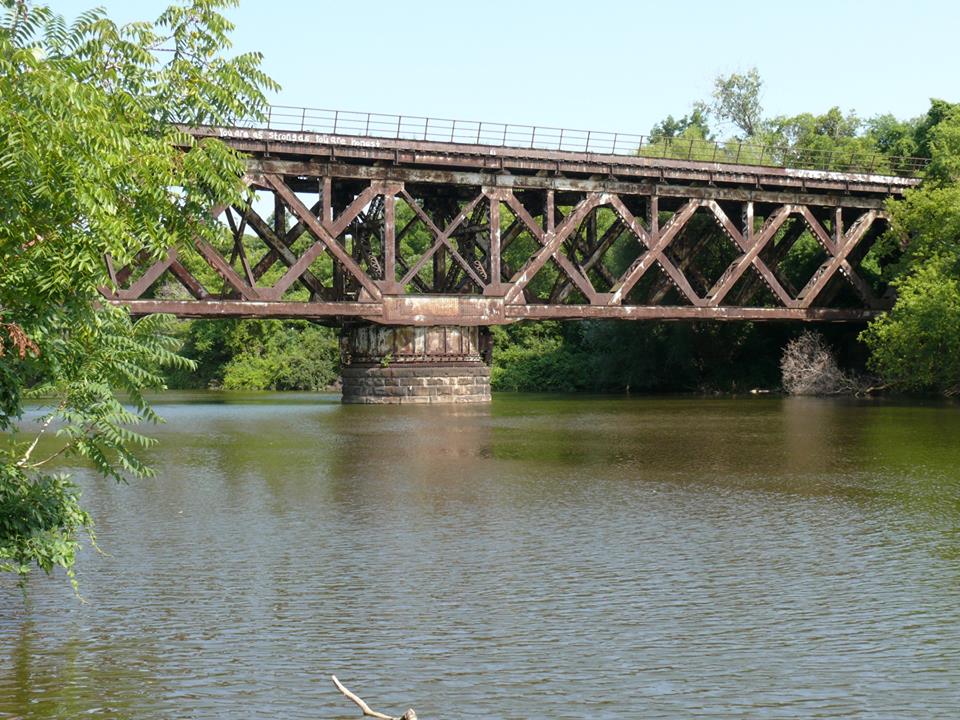
There are a lot of photos of the current Strauss trunnion-heel bridge. Photos of the swingbridge that existed before the tracks were elevated and the river was straightened are rare enough that they deserve there own posting rather than getting lost in the existing posting.
Paul Petraitis posted 11am 9/23/1905, Photo courtesy of the Metropolitan Water Reclamation District Ean Kahn-TrerasWe are looking off of 18th Street in this view. The elevated track is the IC iowa division curving for their crossing of the RI at 16th Street. Mark E. VaughanWasn’t the Erie carfloat interchange operation in this area also? Bob LalichThe Erie Lake Line had two stations, both of which were farther north. Information describing the operations can be found here: http://freepages.rootsweb.com/.../genealogy/erielakechi.html
Bob Lalich commented on Paul's posting The bridge seen here is the SCAL swing bridge. The yard here is C&WI's 18th St Yard. 16th St Tower can be seen in the distance. Here is the smoke abatement map of the area.
Paul's posting is also one of the better views I have seen of Burlington's grain elevators that were next to some slips off the South Branch.
James Boudreaux posted Elevating the St. Charles Airline from Chicago Union Stations' south main line. Bottom L/S quadrant is now Amtraks' 16th St. diesel shop and yard (ex Penn Central, Pennsylvania RR). Upper R/S quadrant is Metras' yard (ex CB&Qs' Zephyr Pit)
Below, in the background, is the Taylor Street rolling bridge in the upright position. It appears that a dredging machine is working under it. Or is it a marine crane that is removing the center pier for the former swing bridge?
Martin G. Sorenson posted Chicago circa 1900. "12th Street Bascule Bridge." Dinosaurs of the ... top (north) bridge is no longer in use - it served the old Grand Central Station (B&O and others) at Wells and Harrison until the late 50s. David DaruszkaThe boat is a tour boat of the recently completed "drainage canal". The Sanitary and Ship Canal was an engineering marvel, and the techniques used in it's construction were replicated at the Panama Canal. [This photo was taken from the 12th Street (Roosevelt Blvd.) Bridge, not of the 12th Street Bridge. This bridge was replaced by the Strauss bridge near 16th Street when the river was straightened.] Mike Savad posted a watercolor of this photo.
Taylor Street's swing bridge would not allow contemporary (1899, 478') ships to pass. The center pier also prevented the 300,000 cubic feet of water per minute flow required to flush the river down the new drainage canal. Removal of the center pier also provided the 120' navigation channel required by the United States War Department for the Chicago River. [eBook, p 696]
The swing bridge still exists in the background of this image of the B&OCT bridge.
Looking through the bridge in the foreground, we can see the Taylor Street swing span on the right and the viaduct to the west that crossed the Pennsylvania and CB&Q rail yards south of Union Station.
"Fig 4 is a general plan of the new Taylor street rolling lift bridge The span from centre to centre of bearings is 148 feet 7 inches. The roadway from centre to centre of trusses is 20 feet in width, with a 5 foot sidewalk on each side." [eBook, p 700]
NJT = New Jersey Transit CSAO = Conrail Shared Assets Operations That means that both CSX and NS trains use it.
This bridge was built with a swing span in 1896. Rather than replace the movable span, they added a 542' lift span with 135' clearance next to it in 1960. The swing span has been taken out of service, but leaving it saved the the cost of removing the center pier of the swing span. It was the first bridge between Philadelphia and New Jersey. [Bridge Hunter] Another reason a lift span was built next to the existing swing span is that the US Army Core of Engineers dredged a deeper channel. [sjrail]
sjrail, cropped Deleware River Railroad and Bridge Company (Delair Bridge) circa 1890
[The following text is from HAER, pp2-5] In 1896, the Pennsylvania Railroad (PRR) was the first to accomplish the goal of spanning the Delaware River between Philadelphia and Camden, New Jersey. For three decades until the Benjamin Franklin Bridge opened to automobile traffic, the PRR's bridge (commonly known as the Delair Bridge) was the only crossing downstream of Trenton. The lower Delaware's extreme width, tidal current, and soft bottom made foundation work difficult, meaning that a successful design would need extremely long spans. When completed, the Delair Bridge had 533'-0" Petit through trust spans. This was an impressive length for the time, albeit a few feet shorter than the Chesapeake & Ohio's 1889 Ohio River bridge at Cincinnati, the record holder at 542'-6". Complicating the design further, heavy traffic on the lower Delaware required a high bridge, or else a movable one. PRR engineers compromised by building the fixed spans 50'-0" above the water and providing a swing span for the tallest vessels. The Delair Bridge is also significant for having set records at two widely separated points in its existence. In the mid-twentieth century, PRR retained Hardesty & Hanover to design a 542'-0'vertical lift span over a new navigation channel proposed by the U.S. Army Corps of Engineers. While setting a record for the longest vertical-lift bridge with two tracks, it was two feet shy of the overall record, set by the New York, New Haven & Hartford's single-track bridge at Buzzard's Bay, Massachusetts, in 1935. As a result, the Delair Bridge hosts an unusual combination of two different movable spans m one structure (although the swing span was subsequently taken out of service). The Delair Bridge is 4,396' long, of which 2,453'-0" is riveted deck girder approach trestles. A lengthy trestle was necessary on the Philadelphia side to carry the railroad over city streets while climbin an 0.7-percent grade to the high truss spans over the river; the New Jersey approach is mostly earthen emabnkment. The girder spans are mostly 40', with some exceptions where the approach crosses Carbon Street (50'-3") and Delaware Avenue (77'-6") on the Philadelphia side. Each trestle bent is supported by four stepped granite footings on a wooden pile foundation. The shore piers, Nos. 1 and 6, are also carried on wooden pile foundations with 190 piles in each group, driven to bearing in a sand and gravel layer and capped capped with a timber grillage at 30' below water level. All of the river piers, Nos. 2 through 5, were excavated by Drake & Stratton using timber caissons; these were rectangular, except for a hexagonal caisson accommodating the cylindrical swing span pivot pier, No. 4. Pier masonry consisted of a concrete core sheathed in large granite blocks 18"to 24" thick, or 30" in the coping, with some blocks weighing more than 20 tons. The river spans originally consisted of three 533'-0" pin-connected Petit through truss spans, one on the New Jersey side of the 323'-0" swing span and two on die Pennsylvania side. Invented by a PRR bridge engineer, the Petit (or Pennsylvania) truss is a variant o fthe Pratt miss, with diagonal members in tension, a polygonally curved top chord, and intermediate floor beams hung from a secondary diagonal system. The intermediate floor beams reduce the length of longitudinal stringers between panel points, making a more efficient structure capable of spanning up to 600'.The fixed trusses are 84'-0" deep at mid-span and divided into 66'-7-l/2" main panels, with intermediate floor beams at half that interval. In the swing span, a 60'-deep pin-connected Petit through truss, the six main panels are each 53'-4", with intermediate floor beams at 26'-8". Pencoyd Iron Works used a traveling gantry crane to erect the fixed spans, each weighing 2,091 tons, on temporary wooden falsework. The swing span (931 tons including machinery) was erected in the open position, using the fender pier as a working platform.Several sources, including PRR annual reports, describe the Delair Bridge as "an iron structure," but this is simply the persistence of a nineteenth-century paradigm for metal bridges; the specifications called for open-hearth steel. The Delair Bridge is most significant for its two movable spans, representing the state of the art in the late nineteenth and mid-twentieth centuries. The 1896 swing span has several innovative features, probably devised by C. C. Schneider, chief engineer of Pencoyd Iron Works' Bridge and Construction Department, who was known for his swing bridge designs.At midspan, two heavy floor beams deliver the truss's weight to the center bearing, an unprecedentedly large steel casting with a phosphor bronze bearing surface 27" in diameter. The Delair Bridge's vertical-lift span represents more man six decades of development in that type. A vertical-lift bridge is defined by a truss raised and lowered between two towers, balanced by counterweights falling and rising at either end. The U.S. had but one long-span vertical-lift bridge in 1896, at South Halsted Street in Chicago, designed by J. A. L. Waddeill. Because of the prototype's expensive construction and questionable reliability, it was not immediately popular. John L. Harrington, Waddell's partner from 1907 to 1913, seems to have been responsible for developing the vertical-lift bridge into a practicable design.Railroads subsequently embraced the design for long-span movable bridges. When, in the 1950s, the U.S. Army Corps of Engineers proposed widening and straightening the Delaware River channel to serve industry upstream, a vertical-lift span was PRR's only option for providing the necessary 500' clearance. The railroad turned to New York-based consulting engineers Hardesty & Hanover, one of several descendants of Waddell & Harrington's partnership. They designed a riveted Warden through truss, 542'-0" long between bearings, to replace the fixed truss west of the swing span. Winding machinery atop each of the towers would lift the span up to 135'-0" above the high-water mark.The Delair Bridge's vertical-lift span represents more man six decades of development in that type. A vertical-lift bridge is defined by a truss raised and lowered between two towers, balanced by counterweights falling and rising at either end. The U.S. had but one long-span vertical-lift bridge in 1896, at South Halsted Street in Chicago, designed by J. A. L. Waddell. Because of the prototype's expensive construction and questionable reliability, it was not immediately popular. John L. Harrington, Waddell's partner from 1907 to 1913, seems to have been responsible for developing the vertical-lift bridge into a practicable design.IS Railroads subsequently embraced the design for long-span movable bridges. When, in the 1950s, the U.S. Army Corps of Engineers proposed widening and straightening the Delaware Elver channel to serve industry upstream, a vertical-lift span was PRR's only option for providing the necessary SOO'-O" clearance. The railroad turned to New York-based consulting engineers Hardesty & Hanover, one of several descendants of Waddeil & Harrington's partnership. They designed a riveted Warden through truss, 542'-0" long between bearings* to replace the fixed truss west of the swing span. Winding machinery atop each of the towers would lift the span up to 135'-0" above the high-water mark. American ridge Co...erected the towers around the existing bridge with minimal interruptions to traffic. Meanwhile, another crew constructed the lift span on falsework atop a barge anchored off the Pennsylvania shore. The spans were swapped out, using the rising tide to lift the fixed span off the piers and the falling tide to lower the lift span into place. Once cables were connected to the operating machinery and counterweights, the new vertical-lift bridge was ready for operation. Crews then demolished Pier No. 2 to clear the channel. The bridge remains in active service today, carrying Atlantic City-bound passenger trains as well as freight.
The SS Marie Leonhardt, an oceangoing ship carrying iron ore to the new Fairless Works steel facility in Morrisville, allided with the bridge at about 12:45pm on Jan. 9, 1959, when the operator did not open it in time. This is one of the few lawsuits concerning allisions that was won by the ship owners. The reason the ship won was because the railroad had signaled all clear, but when it then tried to open the span after a train had passed, it could not because it was rusted shut. [sjrail, philadelphia-reflections] Remember, the bridge has a 50' clearance so the span would seldom be opened. But this inaugural run of an iron ore ship for the new USS plant required the span to open.
When built, the 323' swing span set a record as the heaviest to bear on a center pivot. [HAER, p3] That is the first time I have seen that pivot design. Most big swing spans use a bunch of rollers on the bottom of a big drum as shown below.
Michael Froio Photography posted Delair Bridge, looking west across the 542’ lift span over the Delaware River’s ship channel. Over the years my personal work has led to opportunities to serve commercial clients. I’ll be presenting a lecture Monday, October 22nd in Haddon Heights, NJ about these projects and the logistics of documenting fast paced engineering projects on the railroad. For more information please check out the event link https://www.facebook.com/events/1894687810613435/?ti=ia
Dennis Weber posted A Look @ Freight Cars on CP's Mississippi River Bridge LaCrescent,Mn. 9-2017 CP Train 471.
Originally, it was steam powered. It was converted to electricity in 1952. It is staffed 24/7. [Historic Bridges] It was rebuilt in 1928. The US Coast Guard condemned it in 1998 and ordered that the swing span be replaced with a lift span. So far the replacement has been just talk. This is one of four bridges that island-hops across the Mississippi and Black Rivers between La Crosse, WI and LaCrescent, MN. "La Crosse is one of three places that the Amtrak Empire Builder passenger train crosses the Mississippi River, with the other two being Hastings, MN, and Little Falls, MN." [Weeks]
I'm not exactly sure where this bridge falls for priority. It's a critical line for oil and freight to and from Chicago. However, it depends on who's paying for the replacement (and it probably won't be the railroad). If it's paid for by the coast guard (who is the only ones who want it replaced, due to the navigation channel), it may be a while. It's behind Clinton, Iowa and likely Dubque, Iowa for replacement due to narrow navigation channels. However, the railroad intends to double track the bridges here and further up the river at Hastings within the next few decades, so it may happen then. [Bridge Hunter, Posted September 23, 2015, by John Marvig]
HeavyMovableStructures, Photo 3 in Home Page scroll [The photo is not identified, but it sure looks like this bridge. Unfortunately, the link I was after, http://www.heavymovablestructures.org/assets/technical_papers/Alteration-of-the-Canadian-Pacific-Railway-Drawbridge.pdf, is broke. Poking around the site quickly comes to "Under Construction" text.]
Photographed this RR bridge in the Suez Canal last year while on a ship. One on each side of the canal. Both swing and meet in the middle of the canal. Pretty interesting. Not sure how often it is used with all the traffic in the canal.
Francis Otterbein posted Swing Bridge Cleveland circa 1910. Superior Avenue viaduct over the Cuyahoga River.
Mike Brady commented on Francis' posting Started construction 1875, opened 1878 for traffic and removed in 1923 due to a new bridge. I love this photo of it being built.
Gavin EspositoGavin and 279 others joined RAILROAD BRIDGES, TRESTLES, TUNNELS AND CUTS within the last two weeks. Give them a warm welcome into your community!Surprisingly enough, this bridge was the site of the worse traction railroad accident in American history. On November 16th, 1895, car #642 driven by motorman Augustus Rogers plunged into the Cuyahoga River below when the draw was mistakenly left open. Safety mechanisms were in place to prevent such accidents, a derailer switch was in place on both sides of the draw spaced 100 feet apart, the motorman would have to get out, throw the switch, and climb back on to proceed. Beyond this was a pair of gates that he also had to open, but were driven electronically once the car had passed. The power source failed that evening, resulting in the gates never closing. As car #642 approaches the draw with 25 passengers aboard, motorman Rogers motioned for conductor Edward Hoffman to get off and throw the switch; he obliged and did so. Picking Hoffmann back up the car rolled towards—and then through the gates. Falling some 101 feet into the Cuyahoga River below, it struck an abutment of the bridge and bounced into the Cuyahoga River—killing 17 of the 25 passengers
1932 Bridge Hunter has a timeline of the saving of this bridge. Of note, the MO AG sued the MO DNR director to not give the bridge back to UP. UP wanted to move some of the spans to another project.
Wayne Lammers posted four photos with the comment:
Hi. I'm a new member to this FB page. These are some of my Boonville, MO Katy (MKT) railroad bridge collection. This bridge was built and finished in1873. It was changed over the years and was given to the city of Boonville. We are presently converting it to be a large part of the Missouri Katy Trail State Park. If there is interest, I will post more images of our beautiful 408 foot lift span bridge. The last photo is what it looks like now.
1 Construction of the MKT railroad bridge in 1872.
2 This is the south Boonville entrance to the finished, MK&T RR Bridge. Just look how they built bridges back some 145 years ago!!!
3 This is the reconstruction of the bridge in 1886.
4 From the center of the Missouri River at Boonville, MO
(new window) Shot in 1986. They were still running with cabooses!
(new window) I shoved the position indicator quite frequently.
Katy Bridge Boonville posted An awesome image of the bridge during the flood of 1903 Charles WellsSure looks like "Everything" is under water over at Franklin! Think this was far more a common occurrence than one might imagine, especially during spring and late fall! Too bad the Katy did not build farther up on higher ground!
The US Army Core of Engineers supports a 9-foot channel on the river to Souix City, IA. [USACE] A 2-million pound, 408' long lift span is rather impressive. If it is locked, it would have to be high enough to clear pushboats (towboats). Fortunately, that is not near as high as the old steamboats needed. I have written about preserved lift bridges that have added ramps up to the locked lift span. Of course, I now can't remember where I wrote that. And Google's Blogspot broke the author's search function on April 3, 2018, so I'm not even going to try to find the preserved lift trail.
Looking at some of the elevation shots, this bridge was built for 9-foot channel barge traffic, not steamboats, because the towers are so short. It looks like even fully raised, ramps on the bridge would have to go up just 20 to 30 feet high. It is interesting that I can't find any info on the plans for the lift span. Are they going to hire a state park ranger to operate it or are they going to lock it in the up position and build ramps? The state park system staffing a lift bridge would be a notable preservation, and tourist attraction, option. But if Missouri politicians are as incompetent as Illinois politicians, the state park system won't be funded to do anything noteworthy. (For example, the Illinois state park closed their Tunnel Hill State Trail facility.)
David Daruszka posted three photos with the comment:
Union Pacific (former C&NW) Root River Bridge in Racine, WI. The bridge was designed as a moveable swing bridge, but never used as one. The river traffic never materialized.
David DaruszkaIt was known as the C&NW "Old Line" that ran to Milwaukee. The UP downgraded it to single track and it still carries freight, primarily coal for a power plant.
1
2
3 Peter OberdickIt looks like the gearing was installed. I wonder if it was manual or powered.David DaruszkaGiven the size of the bridge I would assume it was meant to be powered.
This bridge is so massive that it looks too large for its swing pier. This bridge is a very unusual swing bridge because it is a deck truss. Most swing bridges are through truss bridges or plate girders. It is also a fairly large span for a swing bridge. The double-warren truss configuration is uncommon and noteworthy. [Historic Bridges]
Randy King posted North Bend, Oregon Swing span.. largest west of the Mississippi.... with a ship heading to sea... My photo Dennis DeBruler This was a Southern Pacific route, so UP would have acquired it. Since it was (1928) just a branch that started at Eugene and went down to Powers, does UP still own it or did they sell it to a shortline? Warren Caudle Last I saw, the Port of Coos bay has the line from Eugene to Coos Bay. The original line went all the way to Powers. Randy King I think they lease it from UP still... But they (CBR) have to maintain it...
Randy King posted North Bend, Oregon Swing span.. largest west of the Mississippi.... My photo
South of Joliet, Illinois just off Rt6 at the Johns Manville plant is this turn bridge that crosses the historic and now abandoned I & M canal. Though functional in the era of mule towed barges, it sets welded in place. It is still used today as an industrial spur line. It was Elgin Joliet and Eastern in my memory but I think it may be Canadian Northern now.The historic Illinois and Michigan canal linking Lake Michigan to the Mississippi River closed around 1930 when the current I&M opened to much larger barge traffic.
Dennis DeBrulerThe industrial lead goes north to what was the Rock Island. This part of the Rock Island route is now controlled by CSX.
1
2
3
Sydney must have caught after some heavy rains. This satellite image is probably or more normal flow in the canal.
The spindly nature of this bridge caught my eye. It was installed for a narrow gauge railroad for the Drew Lumber Company and was hand cranked. "Built between 1869-1874 at an unknown location, purchased 1899, installed 1901; abandoned 1920." [Bridge Hunter] "This railroad bridge was reportedly moved here from Brazil and put into service at this location around 1901, and abandoned in 1920. Its original construction date is unknown, but it displays cast iron elements and unusual details that are characteristic of early metal truss bridges. As such, this bridge is presumed to be one of the oldest surviving swing bridges in the country, if not the oldest. Its assumed age, unusual design, rare use of cast iron beams, and lack of alteration to the trusses, place it among the most significant historic truss bridges in the country." [Historic Bridges] The bridge is a demonstration that iron, both cast and wrought, doesn't rust as easily as steel does. It has been almost a century since it was abandoned, and I'm sure that nobody has painted it during that time.
Link from Bridge Hunter Trains going across the Drew Bridge, taken ca. 1909. State Archives of Florida Suwannee & San Pedro Railroad train crossing Drew Bridge over the Suwannee River
Reading the comments on Bridge Hunter, I learned that the truss was swept off the pier by a flash flood. Fortunately, it suffered little damage, and it has been mounted back on its pier again. And then I learned that may be "fake news" created by a comment troll. (It is a shame that our society has invented the concept of "fake news.") And then I quit reading the comments.