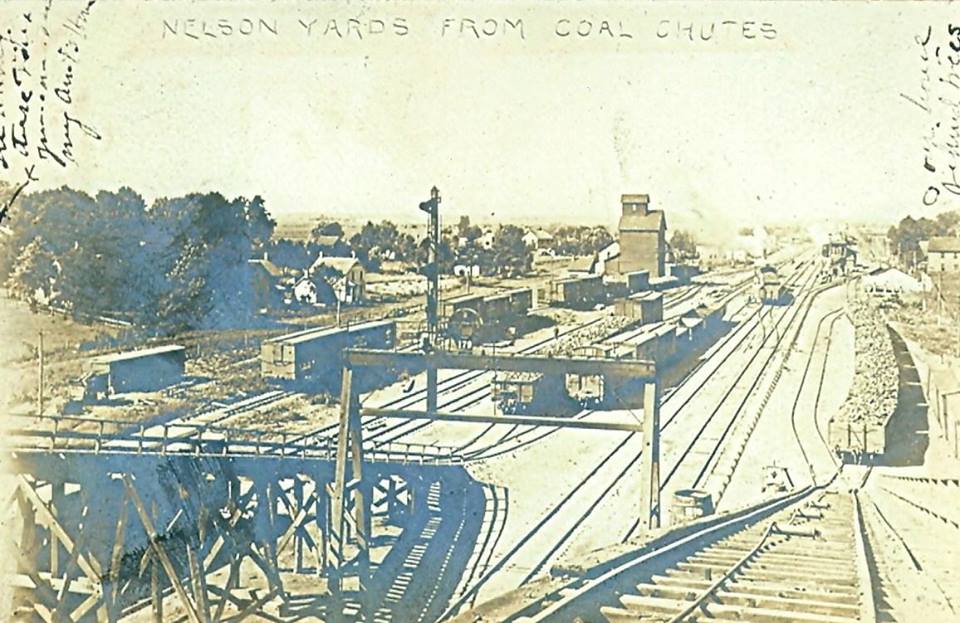
I used to think the .pdf copy was a better scan. But I have discovered that the eBook did a better job with photos. I include copies from both sources for a map so that you can judge which is better. I enlarged both images until they began to show pixels. The .pdf indicated 150%. I could not get a percentage for the eBook, but I would say it was also around 150%.
You probably need to click and image and then save to disk and use a photo viewer to access the full resolution stored by the blog server.
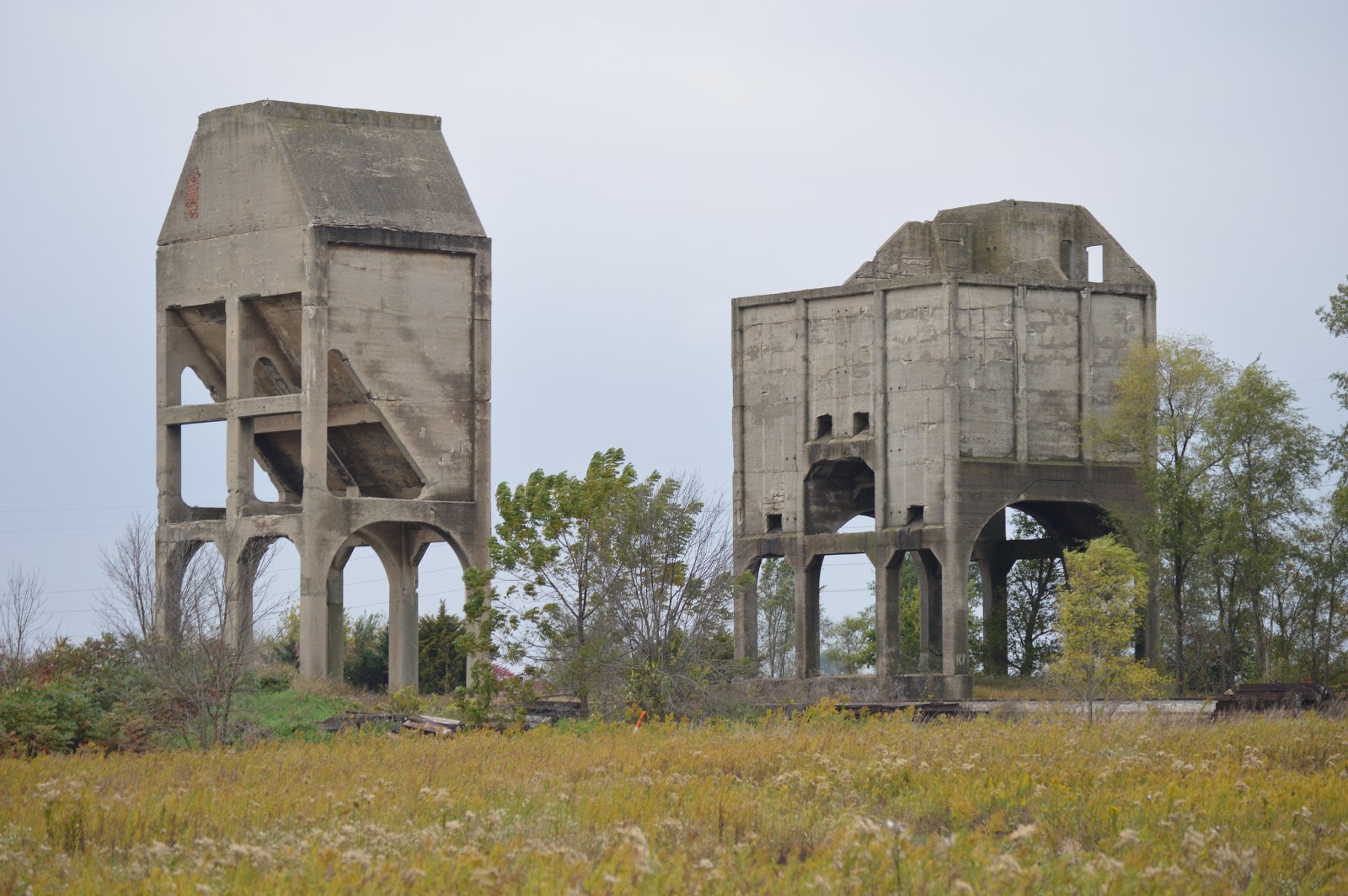
Whenever I see a photo of an existing coaling tower posted, I try hard to locate it. I see I currently have 139 postings labeled with "towerCoal" in my towns blog. I'm amazed by the variety of the designs. Even though a lot of them were made by the same manufacture, there seems to have been little effort in standardizing the designs. Even though the towers have been unused for over a half-century, many of them still stand because they were constructed with reinforced concrete.
Most of the coal towers I have seen have been stripped of their wood and metal parts. So sometimes it is hard to imagine what they used to look like. The comments for this posting taught me about some coaling towers I had not heard of before, some of which still had metal parts. I list some of the existing towers with metal still on them at the end of these notes because they are so rare. For example, these towers north of Gillman, IL looked quite differently when they were being used.
But the motivation for this posting is the comments by Allan MacDonald and Brian Westhouse that taught me that these towers also stored sand. And some of them also stored water. Note that a diesel, as well as a tender, are parked at Gillman's towers above. That indicates the tower contains sand as well as coal. Like steam locomotives, diesels use sand for extra traction.
Special sand towers, along with huge diesel fuel tanks, have been developed for the facilities that service diesel engines.
Dennis Corso commented on a posting Collinwood Yard. NYC on the East side of Cleveland George L HoppertIt stood just out infront of the roundhouse but could be entered by a laborenth of track from the mains. Brought loaded coal cars through the tunnel on the far riht side to dump the coal into the pit below. they didn't fill or cover the pit for decades after they stopped using it . It was filled with black water to the top of the pit. Many trainman fell into the water filed pit while taking a short cut while switching the ajacent tracks. The elevator is just to the left of the pit.George L HoppertDennis Corso I was firing a job, and I got out to help with a move. I was going to take a shortcut through the pit. It was black flat and level just like all the rest of the area. if it wasn't for an old crusty brakeman , I would have gone in. [This was on the mainline between Chicago and NYC, and it is the largest of which I remember seeing a photo.]
Brian Westhouse commented on a posting On this wooden coal tipple (at South Parry, On.) can you see the sand delivery pipes on the corners with supply pipes from near the top. The longer diagonal pipe at the top, delivers the sand to the tower.
The above photo shows that large coaling towers were also made of wood. But of course we don't see them today because wood doesn't last that long. In fact, before they used towers, they used coaling docks made of wood. C&NW in Nelson, IL provides examples of all three generations of coaling stations. First, a couple of photos of the coaling dock from the C&NW Historical Society.
This Jack Delano photo shows the wood tower that was at Nelson, IL. Since it is labelled OWI (Office of War Information), it is one of the many photos of railroading that Jack took during WWII.
Since C&NW built their concrete tower after WWII, it would have been built soon before it was useless. I see it does have some metal parts on the other (east) side. I drove east of the tower on the south side looking for a gap in that treeline to get a photo of the other side. But the only gap I could find was on railroad property.
Back in the steam era, there was a lot of variety among the railroads. So you can find exceptions to almost every convention. For example, EJ&E had separate sand and coaling towers in their Joliet Yard. And the coaling tower was made of metal, which is quite rare. (It looks like the coaling tower had two skip hoists so that one could be used to counterbalance the other.)
When constructed correctly, reinforced concrete is so strong that even using explosives to take them down is problematic. When the Rock Island took one down with explosives, the plan was that it would fall to the side. But it dropped down onto the mainline tracks. Kyle McGrogan commented on a posting: "The one in Decatur, Il is still there as the Wabash used old railroad rail for the rebar. N&W tried to blow it down....No luck. To the railroads, they meant these to go 1000 years at the time they built them."
Every town that had a coaling station would also have had a water tower. Although they were not necessarily across the tracks from each other.
And there were water towers between coaling stations. So there were more water towers than coaling towers. The reason we don't see more today is that most of them were made of wood, and they have disappeared. One that does exist, and is easy to access if you are ever taking a trip on I-57, is in Kinmundy, IL. In fact, IC built a dam to create a little lake to help supply water for this tower. Note how the metal bands get closer together as you go down the sides. That is because the water pressure is increasing. They have roofs because the water is treated with chemicals to help reduce the buildup of scale in the steam boilers. They don't want rain water to dilute the chemical treatment.
For tracks that were used by high-priority passenger trains such as NYC's 20th Century Limited, track pans were used to avoid having to stop for water.
Brian Westhouse provided some specifics concerning the spacing of coal and water towers:
On CNR through Northern Ontario, the divisional points averaged 150 miles maximum with coal and water at each end. Another combined Coal and Water stop was made a the 75 mile mark and two or three water towers between coal stops.
I've read that some railroads had a division point every 100 miles, and travelling to the next division point was considered a days work for the train crew. I know that the town of Garrett, IN was created by the B&O to be a division point. Even though trains are no longer serviced there, they are still very proud of their railroad origins. In fact, trains to Chicago were crewed from Garrett long after the conversion to diesel locomotives. They would be cabbed to a motel in Chicago, and then the next day they would run a train back home.
Since Champaign, IL, was a division point, the coaling facility that we see at the top of these notes that was in Gillman, IL, is an example of a coaling station that is about halfway between division points. The Kinmundy water tower was probably an example of an intermediate town that supplied just water.
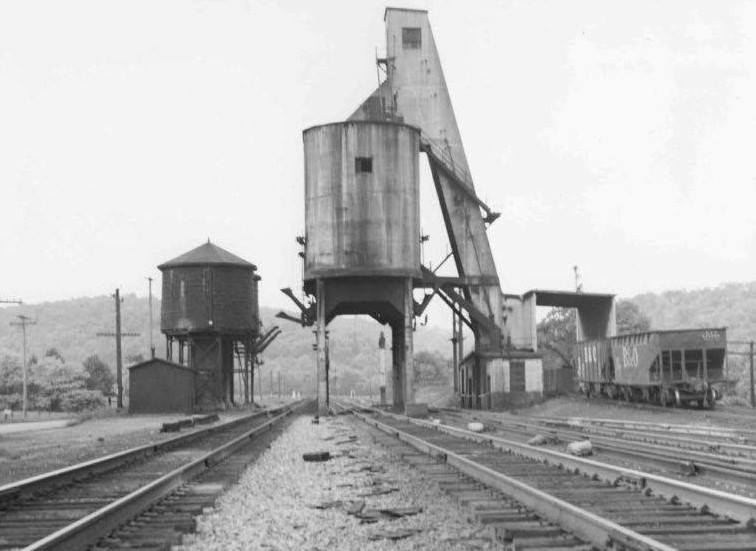
Sometimes they incorporated water storage in with the coaling tower.
Harold Hoskins commented on a posting [On this side of the two coal chutes, there appears to be a water spout. So the silo is probably a water tank and the coal bins are behind it. Note that they have a separate sand tower in front.]
Sometimes the train crew improvised to get water.
Brian Westhouse commented on a posting I took this picture in 1970 about 98 miles north of Toronto. The coal tipple still standing has been long out of service. The 4-8-4 at the head end of this consist is taking on water from the river, being pumped by the local volunteer fire dept.
Examples of towers that have at least some of their metal parts left
Since the metal parts are tracks, the tower would have used a skip hoist instead of a bucket elevator. Skip hoists were also used to charge blast furnaces, so the "new window" for this video shows a skip hoist in action. (new window)
I don't normally discuss train wrecks other than tank car safety implications. But I read about three wrecks in one evening. That exceeds my rule of writing about a topic if I see it mentioned a couple of times within a couple of days. And an important part of the history of railroading is the improvement of safety.
The Janney (knuckle) coupler and air brakes are examples of equipment the railroads were required to convert to in the 19th century because they improved safety. Using roller bearings instead of friction bearings is an example of a rule that went into affect during the 20th Century to improve safety. (Roller bearings also reduced a lot of labor requirements. And, unlike coupler and air brake changes, not all cars had to change at the same time to be compatible. So the railroads converted most of their cars without a rule. But it is now a rule, and now museums have trouble getting cars they purchased transported to their museum because they are old and have friction bearings.) The replacement of hand signals with radios is a 1970s improvement.
Since at least 2014, the railroads have been replacing their relay-and-copper-wire-based signalling with computer-and-fiber-optics-based signalling to implement Positive Train Control (PTC). Unfortunately, newer is not always better. The crossing gates over Main Street in Downers Grove have had many false closings after the new equipment was cut over. (During the 40 years I lived in town with the old signalling equipment, I never saw a false closing.) They turned on PTC for BNSF commuter trains this year. To do that, they had to change the schedules because it takes longer to change the direction of the locomotive after arrives at the end of the line. The increased turnaround is cause by needing to reboot the PTC equipment. The new schedule caused a lot of overcrowding of some trains. Recently, I saw a headline in the Chicago Tribune about the trains having a 45-min delay because of signalling problems. And today [11-3-2018], WGN had a report blaming PTC for ongoing train delays and further delays of much needed engine and car replacements. (source)
Sometimes improved safety is not an invention but another safety rule. For example, outlawing the poling of cars and outlawing a flying switch. But these two rules no longer have much impact on a crew's productivity because carload rail service to industrial plants has practically disappeared compared to what it was a century ago.
Another safety rule that some railroads have written is that the trains must be completely stopped before someone can get on or off of it. That rule is currently controversial. When doing switching work it was quite common to get off and on a train that was moving at a walking speed. In fact, I've seen a 1940s NYC safety training video about the correct way to get on a slowly moving train. This rule is currently controversial because it does reduce the productivity of a crew.
1969: IC Rear-End Collision, 3 Fatalities
Dave Ladislas Sr. posted the question: "Anybody recall the bad IC train accident over the Cal-Sag,on the bridge just N. of Riverdale in like late 1969 involving a coal train and an auto-rack train? I think the crew on the coal train was killed,a few autos ended up in the river,and still there,supposedly."
Jon RomaI was but a child when it took place on September 26, 1969, but I have read the accident report. The crew of a northbound train, Extra 5055 North, fell asleep due to the effects of fatigue and alcohol, passed stop signals, and rear-ended a standing train, Extra 1214 North.
David Daruszka commented on Dave's posting Jon RomaNotice that the caboose body is completely sheared off the frame, and the engine is pretty much crumpled. The accident report estimates that the collision speed was close to 60 mph.
I was surprised when I read the conductor's testimony. Obviously, he told what should have happened, not what did happen. The report indicates he should have prevented this accident by not letting the engineer get on the train in the first place because he must have been obviously drunk. I wonder if a conductor in the caboose can hear the horn blowing for crossings. Or does the horn facing forward, the train being long, and the caboose being noisy not allow the conductor to hear the horn? As the report indicates, he had at least a second chance of preventing the accident when he saw the train was not properly slowing down for the metro area because there is an air-brake valve in the caboose.
I've been reading the stories that a couple of engineers have been posting on Facebook. One thing I have learned is that drinking on the job was remarkably common back in the 1960s. In fact, it was a good thing they had a crew size of 5 people because some guys were known to go to sleep on the job because they drank too much. I know that Major League Baseball learned that just writing the rule "don't use drugs" doesn't do the job. They had to also do random testing for drug usage. The railroads don't care about Performance Enhancing Drugs. But they must care about drugs that impair performance. I don't know what the current practice is concerning random testing for alcohol, cocaine, opiates, etc.
The hours-of-service rules have changed. Now a crew can work only 12 hours and must be given 8 hours off before they can work again. I could never have been an engineer because I have enough insomnia issues that I could not get enough rest in 8 hours.
The replacement of the caboose by an End-of-Train Device (ETD) removes the risk of a crew at the end of the train being hit by a following train.
Researching the history of the "dead-man switch" and how to defeat them goes on the todo list.
This is the type of accident that PTC should prevent.
To summarize the report, there were at least two problems. One was that the air hose was getting pinched or kinked when the slack was bunched. Two, the ETD did not respond to the emergency stop control. I hope I catch the final report to learn the root causes of these problems. I wonder if the 28cfm train line leakage is typical or excessive.
Nov 2018: BNSF train on UP tracks hits truck and all three engines derail, 0 fatalities
PTC would not have prevented this accident. Rope Bairrington shared four photos, Michael SmithMP 126 on the Glidden sub near Flatonia, Texas.
1
2
3
4
A closeup of the second photo indicates that the hillside may be what kept the locomotives from rolling on over.
2, cropped x2
Some comments indicate the truck was an oilfield frac pump. A Google result indicates that they can cost over a million dollars. It looks like its frame is rather long and low. Maybe the crossing is on a "hill" and the trailer got hung up on the tracks.
There were quite a few comments on the share as to why the ties now look bad. Some say they look bad because heavy locomotive wheels rolled over them. Others say they look like they were bad before the collision, and they could be the reason the locomotives came off the tracks. Looking at the photos, the trailer was drug a long distance and torn apart in the process. Perhaps a big piece fell under the front of the lead locomotive and that forced the wheels off the track.
Nov 2018: deliberate derailment of a runaway 286-car iron-ore train
"BHP [an iron-ore mining company in Australia] has attributed last week’s runaway train derailment in the Pilbara to a combination brake system failure and incorrect operating procedure." This train had two braking systems: air and electric. The air provides power to push the brake pads against the wheels. It seems their electric system doesn't control air pressure but uses electricity to provide the power to push the pads. The air system is an emergency backup system. The driver got off to inspect a car. The first mistake is that the driver did not engage the emergency air brake before leaving the locomotive. This was a violation of the relevant operating procedure. Secondly, the electric braking system that initially stopped the train automatically released after an hour while the driver was still outside. [TheWest] This is just a preliminary report. Why would someone program a brake system to autonomously release itself after an hour? If I surmise correctly that the electric system uses electrical power to apply the brakes, then maybe it would overheat after an hour of continuous application. In which case not setting the air brake is an even bigger no-no.
Runaway Paraffin Wax Tank Car
PTC would not have prevented this accident.
Did someone not bother to set a hand brake? A car need not be on a hill to start rolling. The industry has worked very hard to remove friction from rolling bearings. I have read about wind blowing cars uphill on hump yard tracks!
(new window) from mcall from posting Fortunately, the car activated crossing signals. I've read that some systems need about six cars to have enough axles to activate the signals. The article says "Norfolk Southern employees were able to slow the car and board it at a slow speed, when they used a hand brake to stop it." I wonder how they slowed it. If they had coupled to it with a locomotive, then they could have just stopped it with the locomotive. The car traveled about 11 miles.
Heat kinks, especially after the ballast has been disturbed by track resurfacing (tamping)
Unless PTC includes some really fancy rail break and kink detection sensors, it would not prevent these types of accidents.
This is from a closed group, I hope everyone can access the "posted" link in the caption. There is a lot of "real world" information in the comments.
In the case of William's story, the track was bent by a coal train passing over it. Someone speculated that the coal cars started rocking back and forth causing lateral forces that moved the track. The more common cause for bent track is "heat kinks" in the summertime. The heat causes the track to expand so much that the ties can't handle the compression forces in the rail. It is ironic that just after resurfacing a track, it is more dangerous in the summertime.
Not only should PTC be able to detect broken rail, some old signalling systems could turn signals red if a rail broke.
The opposite of a rail kink in the summertime is a rail pull (break) in the winter time. The cold causes the rail to contract until the tensile strength of the rail is exceeded. The weather has turned cold and I'm seeing reports of more than one derailment due to a "track problem."
Six grain cars tipped over in Owosso, MI, blocking the first North Pole Express run of the season that was running behind it. They had to find a lot of school buses to haul the passengers back to the station. A crossing was closed for a couple of days. [25news]
A big one this November was CSX in Byromville, GA. I noticed in one of the photos that the bridge still has ACL panted on it. So this was a former Atlantic Coast Line route. If you are a CEO installed by a hedge fund manager, would you choose to use your revenue to buy back shares or to do track maintenance?
There were no injuries, but several [30] cars were dumped off or near an overpass. The number of cars derailed impacts the cleanup time, but not the impact on the people in the town other than traffic hassles. However, some [4] of those cars were carrying odorless propane. This caused most of the town to be evacuated and a long detour around the potential hazard. Who pays the motel and restaurant bills for the people that are forced to leave their homes? (A sharedpost indicated the evacuation was lifted the same day it was called, 11/18/2018. A comment indicated that none of the tank cars leaked propane.) A report [13WMAZ (source)] said it derailed near Main Street. But looking at satellite images, it derailed on the main road through town, not Main Street. It was fortunate that no one driving on the highway got hurt, or worse. The derailment was mid-train, so the train crew was safe.
Sandy Swb posted eight photos of the derailment in Byromville, GA. Alex Marksbridge collapsed
2
5, cropped
6, cropped
When I looked at this photo, I thought the propane tanks were near the end of the cut that left the tracks. That means they would have been slowed down because of emergency braking caused by the broken airline and the shock absorbing action of the boxcars and hoppers in front of them. So they "gently" rolled off to the left side of the photo. I'm seeing conflicting reports concerning the damage to the bridge. They range from its OK to it needs to be replaced.
Fortunately, I came across this video from a Dooly County Sheriff squad car dashcam. It looks like the propane tanks were at the beginning of the cut! So they not only left the track at full speed, those other cars probably shoved into them.
The Chicago Tribune had a report in their section of little reports from around the world. I still get the paper delivered because this little newsprint blurb had more information than any news report I found on the web. I've transcribed the report.
No injuries reported after rail cars fall from Georgia overpass BYROMVILLE, Ga. --- Rail cars tumbled from an overpass onto a Georgia highway on Saturday, causing an evacuation and traffic headaches in a small town but resulting in no injuries. CSX Railroad said 30 cars derailed. That included some that fell from the overpass onto Highway 90 at Byromville, 55 miles south of Macon. Resident Stephanie Chapman said she was on a deer stand more than a mile from town when it happened. "You could hear the rail cars hitting each other --- boom-boom-boom-boom-boom," Chapman said. It happened around 7 a.m. Saturday in the town with a population of about 500. CSX said four of the cars held petroleum liquefied gas. No leaks were reported.
"Crews are working to re-rail the cars without damage and remove the derailed railcars with damage from the area as quickly and safely as possible," the CSX statement said.
The thing that frustrates me about web "news" is that it isn't much more than the platitudes sent out by the PR department. Now if CSX said we are going to wait until Monday before we start the cleanup because we don't want to pay overtime, that would have been news.
Not all broken rails cause accidents. A story posted by William O'Neal Stringer in a EJ&E group:
One fine day I brought the coal train into Joliet from West Chicago and left it on the run-through track so I could run around it with the engines and take it to Romeoville. Everything was fine as I started out but when I got up near the bridges over the small river and the BNSF my engine physically dropped quite a bit going over a certain spot on the left side. I could also hear a sound like a wheel going over a bad rail joint. I was only going 10 mph and uphill so I made so I made an easy stop before the second 3 axle truck on the engine ran over that spot. I went outside and started looking and there it was, the rail was broken all the way through and there was no cross tie under it. The rail is pretty forgiving but I wasn't willing to take the entire 110 plus 100-ton hoppers over it. Might not derail but it sure could. I called the dispatcher and reported my find and told him I thought we could gently run back over that spot with the engine and shove the train back into the yard. We had a utility man helping us so he protected the move from the rear end. My conductor was out on the ground at that spot and watched closely as we tippy-toed back over it. In years past that kind of responsibility was rewarded by the J with a Chevron and a savings bond for saving them thousands of dollars and tieing up the railroad over Bridge 198 but they had already quit doing that years before to save money I guess. That broken rail was under my engineer's seat when I brought the train in and I didn't feel it then so it must have happened after my engine passed over that spot which is entirely possible. Sometimes things just don't feel right.Just another day on the J.
Rail repair used to use fire along the rail to heat it up so that it would expand and close the gap. Now they have hydraulic grippers than can pull the rail back together.